|
|
TCC in the News: | CNS
| WND | WashPost | Tuscaloosa
| Birmingham
| WND
ACTION: Sign Petition Against Judicial Tyranny Petition!
TCC
Supreme
Court Resources
Interviews
with Howard Phillips by Dan Flynn at FlynnFiles:
[ Part
1 | Part
2 | Part 3 |
Part 4
]
Interview
with Howard Phillips by LifeSite on Judge Roberts
CDs of TCC's 2005 Constitution Day
Event will be available soon
|
Home
| March 2006
Archives
|
|
Social Security
for Americans Only |
March 31, 2006
|
February 9, 2006
Hon. James McCrery
Chairman
Subcommittee on Social Security
Committee on Ways and Means
U.S. House of Representatives
316 Rayburn House Office Building
Washington, D.C. 20515
Dear Chairman McCrery:
During the past two years, The
Conservative Caucus has delivered to the subcommittee a total of 71,500
petitions supporting H.R. 489, the legislation introduced by U.S.
Representative Ron Paul to protect Social Security funds from being drained
by non-citizens.
Accompanying this letter are an
additional 44,400 petitions supporting Congressman Paul’s bill, now
reintroduced as H.R. 858, the Social Security for Americans Only Act.
The proposed agreement with
Mexico would endanger the already doubtful solvency of Social Security.
Given that Social Security is not an insurance system, but rather a
government benefits program, there is no reason to continue allowing
non-citizens to retain eligibility. This is especially true of those who
have been in the United States illegally.
I appreciate your consideration
and look forward to hearing of the action you decide to take.
Respectfully,
Howard Phillips
Chairman
|
Repeal
Clinton Social Security Tax |
March 24, 2006
|
February 8, 2006
Hon. Dennis Hastert
Speaker
U.S. House of Representatives
U.S. Capitol, H-232
Washington, D.C. 20151
Dear Mr. Speaker:
Accompanying this letter are
petitions from 34,000 members and supporters of The Conservative Caucus,
calling for repeal of Bill Clinton’s 1993 tax increase on Social Security
benefits.
This tax unfairly singles out
one segment of our population for an increased tax burden. Moreover, it
involves triple taxation on those who, along with their employers, have
already been taxed to subsidize their Social Security benefits through a
lifetime of FICA payments.
This scheme of taxation should
be overturned. The Senate finally voted to do so last year. The House
previously voted for repeal in 1995 and 2000. It is time to finish the job.
I hope you will make repeal of
this unfair Clinton tax a priority this year.
Respectfully,
Howard Phillips
Chairman
|
Federal
Entitlements |
March 23, 2006
|
SOCIAL PROGRAMS
HAVE BALLOONED BY 17% UNDER BUSH
According to the
Office of Management and Budget, Medicare and Social Security annual
reports, and information from the Internal Revenue Service set forth in USA
TODAY, 3/14/06, "Enrollment in Federal social programs grew 17%
from 2000 to 2005, the biggest five-year increase in 40 years."
In 2005, 53.4 million
Americans were enrolled in Medicaid, a jump of 50.4%, and the Federal cost
had grown to $198 billion. Enrollment in Social Security was up 6.3% to 48
million persons, with an annual Federal cost of $519 billion. Medicare had
grown by 6.6%, with 42.3 million participants and a total Federal cost of
$294 billion.
Child nutrition
programs had increased 8.9% to 32.3 million children for a total cost of $12
billion, and the food stamp program had grown to an annual cost of $33
billion with 25.7 million participants, an increase of 49.6%.
The earned income tax
credit, which provides tax payments and tax reductions to low-income
families, now includes 21.2 million recipients, many of whom pay no taxes at
all. This represents an annual cost of $35 billion, a boost of 13.3%.
Unemployment
compensation has increased 16.8% to $33 billion per year, with 8.1 million
beneficiaries.
Pell grants, which
unconstitutionally help pay college costs, now involve 5.1 million
recipients, an increase of 33.1% since 2000, at an annual cost of $13
billion. Veterans’ benefits now cost $40 billion and welfare costs the
American taxpayer $21 billion.
Medicaid overtook
Social Security in 2004 as the government’s largest social program.
President Bush’s new Medicare prescription drug benefit will cost an
estimated $54 billion in 2006.
Setting aside the
question of Constitutionality with respect to these programs, the policies
of Congress and the White House have contributed markedly to their expansion
and the burden they place on the American taxpayer.
|
Line
Item Veto |
March 17, 2006
|
President Bush’s State of the Union call for a line-item veto is wrong
from both a Constitutional and policy standpoint, but it is a predictable copout for
a President who has not used the veto rescission or impoundment authority
which he has been granted.
Here are some of the reasons, which I set forth in March 1995 spelling
out why a line-item veto would be destructive, counter-productive, and an
unwise enhancement of Executive power vis-à-vis the Legislative Branch:
CONSTITUTION'S DELICATE BALANCE CONCERNING PRESIDENTIAL
VETO SHOULD NOT BE SUBJECTED TO ILL-CONSIDERED LEGISLATIVE
TINKERING
|
CONSTITUTION OF THE UNITED STATES
|
|
ARTICLE I, SECTION 7, CLAUSE 2: Every
Bill which shall have passed the House of Representatives and the
Senate, shall, before it becomes a Law, be presented to the President of the
United States; If he approve he shall sign it, but if not he shall return
it, with his Objections to that House in which it shall have originated, who
shall enter the Objections at large on their Journal, and proceed to
reconsider it. If after such Reconsideration two thirds of that House shall
agree to pass the Bill, it shall be sent, together with the Objections, to
the other House, by which it shall likewise be reconsidered, and if approved
by two thirds of that House, it shall become a Law....
|
|
ARTICLE I, SECTION 7, CLAUSE 3: Every Order, Resolution, or
Vote to which the Concurrence of the Senate and House of
Representatives may be necessary (except on a question of Adjournment) shall
be presented to the President of the United States; and before the Same
shall take Effect, shall be approved by him, or being disapproved by him,
shall be repassed by two thirds of the Senate and House of Representatives,
according to the Rules and Limitations prescribed in the Case of a Bill.
|
The very first line of the Constitution makes clear that the carefully
calibrated separation of powers and balance of authority stipulated in the
Constitution of the United States ought not be lightly transgressed. In
the first sentence after the Preamble, Article I, Section 1, asserts:
"All legislative Powers herein granted shall be vested in a Congress of
the United States, which shall consist of a Senate and House of
Representatives."
PRESIDENT SHOULD BE CHIEF EXECUTIVE, NOT SUPREME
LEGISLATOR
In Article II, Section 1, the first sentence states: "The executive
Power shall be vested in a President of the United States of America." Clearly,
the President is to be our chief executive, not our supreme legislator.
Moreover, the Constitution is already quite generous in its grant of veto
authority to the executive, enabling him (if sustained by one-third plus one
of the members of one house of Congress) to reject any and all
appropriations, and, indeed, to even prevent the continuation of programs
authorized by the Congress.
CONGRESS HAS ALREADY SURRENDERED TOO MUCH
AUTHORITY AND RESPONSIBILITY
America today is on the verge of a crisis of political legitimacy, and
has long been in the grip of a crisis of political accountability which has
resulted from the abdication by Congress of its legislative authority and
responsibility.
Congress has unconstitutionally delegated law-making functions to the
Federal Reserve, to the judiciary, to the civil service, to non-profit
corporations, to regulatory agencies, and to the institutions of the New
World Order.
The dangers of an executive dictatorship are at least as significant as
any threat which might be posed by a runaway Congress. With a
"line-item" veto, Congress (and particularly the House of
Representatives - intended to be "the people's body") may be
unable to thwart a President, who, for example, enthralled with the New
World Order, might use his authority to dismantle and destroy the defenses
of the United States of America.
The President of the United States already possesses authority to reject
legislation (a) in toto, (b) by category, (c) on Constitutional grounds, and
(d) to protect Constitutionally assigned executive responsibilities. Why
create new authority, when sufficient powers exist.
POTENTIAL FOR EXECUTIVE BLACKMAIL SHOULD NOT BE
ENHANCED
There are two main dangers which would result from the radical extension
of "line-item" authority: one, Presidents could blackmail Senators
and Congressmen to support policies with which they disagree by threatening
to single out for elimination particular elements of policies and programs
with which they do agree. Thus, for example, Bill Clinton might persuade
a key Senator to vote to confirm one of his nominees to the Supreme Court of
the United States lest, by failing to do so, the Senator cause the President
to eliminate funding for some vitally needed defense project.
PRESIDENT COULD TARGET TAX POLICY BY CLASS
Conversely, the President could enjoy the public applause of signing a
"tax reform measure" while eliminating all tax relief benefits for
individuals above a certain level of income, even though such tax relief had
been an integral part of a carefully crafted legislative compromise.
Presidents already have extraordinary leverage with members of the
House and Senate. Many Congressional spouses are direct employees of the
Executive Branch who serve by Presidential appointment. During the
Reagan-Bush years, Phil Gramm's wife, Wendy, enjoyed high pay status as
chairman of a major Federal regulatory agency, thanks to the favor of the
White House. Elizabeth Dole served in Ronald Reagan's cabinet while Bob Dole
was the Republican leader in the U.S. Senate. They were not alone. Today,
Ann Bingaman is an assistant attorney general at the Justice Department,
while her husband, Jeff, is the Democratic Senator from New Mexico. The
income of Iowa Democratic Senator Tom Harkin has been supplemented by Mrs.
Harkin's pay as a key Presidential appointee at the Overseas Private
Investment Corporation (OPIC).
Presidents can already make key determinations, absent legislative
prohibition, about where bridges will be built, bases will be established,
etc. The power of the Executive Branch is extraordinary. If you increase the
President's legislative powers, you might as well send the Congress home
and let Bill Clinton and his successors rule by Executive Order (of
course, to the extent that Executive Orders purport to set policy, rather
than to merely implement it, they are entirely in conflict with the
Constitution).
A "line-item" veto scheme was approved by the U.S. House of
Representatives on February 6 by a vote of 294 to 134 and a separate version
by a 69-29 vote in the Senate on March 24. Soon, a conference committee will
meet to resolve differences.
According to The Washington Post (2/7/95, p. A1), "The House
timed its approval of the line-item veto to coincide with the 84th birthday
of former president Ronald Reagan, who supported similar powers when he was
in the White House. The Republican-controlled Congress has promised to
give a Democrat what a Democratic-controlled Congress would not give Reagan."
(Ed. note: authority which Reagan did not need, but the purported lack of
which was used as an excuse for his failure both to use existing veto
authority and to propose major cuts.)
WILL BILL CLINTON "LINE-ITEM" SDI?
"No one knows how President Clinton would use the power. But
Republicans this year are proposing spending for items like the ‘Star Wars’
missile defense system that Mr. Clinton might be expected to delete." (N.Y.
Times, 2/7/95, p. A1)
The only Republicans who voted against the measure were: Helen Chenoweth
(ID), John Myers (IN), Marge Roukema (NJ), and Bud Shuster (PA).
According to Shuster (Washington Times, 2/8/95, p. A11), "‘It
puts too much power into the hands of the president. And if it should be
done at all, it should be done by constitutional amendment because it's
changing the fundamental checks and balances of the Constitution,’ he
said.
"The ‘power of the purse’ is granted specifically to Congress
by the Constitution, said Rep. Helen Chenoweth, Idaho Republican. That power
cannot be given away to the president.... ‘Speaker [Newt] Gingrich
included the Federalist Papers on his recent list of suggested readings.
Well, I read them,’ she added."
Unfortunately, no recent Republican President has used existing authority
to oppose unconstitutional spending, or even to insist on a balanced budget.
Neither Ronald Reagan nor George Bush ever proposed a balanced budget. The
last Republican President to do so was Dwight Eisenhower, the last Democrat,
Lyndon Johnson (in FY 1969).
The argument is given that (as matters now stand), in order to get at a
bad proposal, the President would have to close down the entire government,
or at least threaten to do so, hoping that Congress would retreat in the
face of such a threat or such a veto. But this is nonsense. It is very
clear that any President who is really serious about controlling runaway
spending (or even excising minor provisions of major bills) can do so if he
has the courage and determination to confrontationally insist on his
position.
SUPREME COURT HAS USED "LINE-ITEM"
VETO RE CONSTITUTIONALITY
As University of Alabama history professor Forrest McDonald pointed out
in The Wall Street Journal (3/7/88), "The Supreme Court, in Marbury
v. Madison (1803), established the precedent that its power was of a
line-item nature: It declared that Article 25 of the Judiciary Act of 1789,
not the entire act, was unconstitutional."
FRAMERS INTENDED PRESIDENTS TO HAVE "REVISIONARY"
POWER
In a July, 1991 article published by the Cato Institute, J. Gregory Sidak
and Thomas A. Smith observe that "The word ‘veto’ does not appear
in the Constitution. What is commonly called ‘the veto power of the
president’ actually appears in Article I, section 7, clause 2"
(quoted above).
"During the Constitutional Convention of 1787 and in The
Federalist, the Framers referred to what we call the veto as the ‘revisionary
check’ or the ‘revisionary power.’...if ‘revision’ means ‘critical
or careful examination or perusal with a view to correcting or improving’
- as the Oxford English Dictionary indicates that British legal
scholar Blackstone used the word in writings dating from 1768 - then the
Framers might have envisioned the president exercising his veto on something
other than an all-or-nothing basis...."
DEFINITION OF "LINE ITEM" IS CRUCIAL
"The analysis of the item veto is complicated by the fact that it
can take at least four different forms, and each of these forms poses
different constitutional questions....
(1) "....Congress often issues detailed instructions for the
expenditure of appropriations, not in the appropriations bill itself but in
an accompanying committee report. As President Bush noted in the signing
statement accompanying the enactment of one new law, ‘Congress cannot
create legal obligations through report language’ and consequently ‘such
language has no legal force or effect.’ Where objectionable
expenditures are required by the committee report and not by the bill
itself, the president is not bound to spend as Congress instructs."
(2) "The second form of the item veto is the ‘subject veto’ -
the veto of nongermane provisions that usually are riders to larger pieces
of legislation. A subject veto would sever distinct additions from the
larger bill. Congress often uses such legislative bundling to protect
controversial provisions (often separate measures in themselves) from
veto...."
(3) "The president might possess a third kind of power similar to an
item veto - the power of ‘constitutional excision’ - which enables
him to excise sections of a bill that he believes are unconstitutional on
their face...."
(4) "The president might assert a fourth type of veto over a
specific section of a bill if he thought that it would unconstitutionally
impede his execution of his duties and prerogatives under Article II...The
‘shield veto,’ a variant of constitutional excision, would be
applicable only within the boundaries of his authority under Article II.
Its name is suggested by Alexander Hamilton's thesis in Federalist
No. 73 that the first purpose of the veto is to ‘serve as a shield to the
executive’ against the ‘depredations’ of Congress...."
APPLES AND BANANAS ARE EACH FRUIT, BUT NEED NOT
BE DIGESTED SIMULTANEOUSLY
"‘[B]ill’ is not defined in the Constitution....Perhaps it was
thought to be an elemental concept. The Framers probably could not have
contemplated legislative bundling on the scale that Congress indulges in
today....
"....The Framers might have agreed that if Congress claims that a
‘bill’ is everything it produces in a session, then the president may
with equal justice (and more common sense) treat as a separate bill each
part of this legislative product that addresses a single subject. Thus,
perhaps a ‘bill’ about the proper weight of turkey parts, military
salaries, and a thousand other subjects could be treated as many bills, no
matter how Congress styles it.
"The text of the Constitution provides some support for this
inference from the structure of the Framers' design about the proper meaning
of ‘bill.’ The presentment clause speaks of ‘Every Bill’ being
presented to the president. This phrase presupposes that the president's
approval would be sought and required on numerous proposed laws rather than,
in the extreme, one big law....
"....Whether the Framers thought Congress had, as an inherent part
of the legislative power, the authority to bundle legislation is not the
question; it is, instead, whether the Framers also thought that the exercise
of an item veto in some form was (or would be) a constitutionally
appropriate response to such bundling. Indeed, if they thought bundling was
permissible, it might have been because they thought the abuse of this power
would, in the end, provoke a concomitant exercise of the presidential veto
power, especially because the Framers thought that the first function of the
veto was to protect the president from legislative encroachments...."
FRAMERS PROVIDED FOR VETO BY CATEGORY TO PREVENT
CONGRESS FROM USING "BUNDLING" TO NEUTRALIZE EXECUTIVE AUTHORITY
"At the Constitutional Convention, moreover, James Madison
proposed adding clause 3 to Article I, section 7, in order to extend the
president's veto power to address ingenious packagings of legislative
proposals that might otherwise escape veto under clause 2. He wrote: ‘If
the negative of the President was confined to bills, it would be
evaded by acts under the form and name of Resolutions, votes, &c.’ The
addition of clause 3 revealed the Framers' concern about evasion of the
presentment process. Their response was not to forbid such legislative
maneuvering - surely a hopeless task - but to make clear that the
presentment requirement and the veto power applied to all measures produced
by Congress purporting to have the force of law. Congressional bundling
does not seem far removed from calling a bill a resolution in order to avoid
presentment. Both are ways to vitiate the veto power."
The bottom line is this. When Congress puts together apples, oranges, and
bananas in one fruit basket and says to the President take it or leave it,
by the Framers' design, the President can take the apples and oranges and
reject the bananas.
Perhaps a better way to characterize the Constitutional powers which
currently inhere in the President is by asserting that they represent the
ability to veto by category rather than to go within a category to pick and
choose as to which defense items will be preserved, which will be
abandoned, which educational programs will be subsidized, which will be
rejected, etc.
Even liberal Republican Congressman Tom Campbell (R-CA) argued that some
form of "line-item" authority is already there, observing (Congressional
Record, 5/16/91, p. E1803) that "The intent of the Constitution is
clear: Congress passes bills, the President looks at each one; he approves
some and vetoes others; Congress gets to override any veto by a two-thirds
vote.
"But suppose Congress combined all bills for an entire session into
one huge bill....Such a ploy by Congress would effectively take away the
veto power. Clearly, this is a distortion of the intended constitutional
process."
"LINE-ITEM" VETO, AS OPPOSED TO
CATEGORY VETO, COULD THWART EVEN A SUPERMAJORITY
One conservative who has been consistent in his opposition to changes in
the Constitution with respect to the veto has been Mickey Edwards, formerly
a GOP member of Congress from Oklahoma. Edwards wrote in The Washington
Post (2/8/84) that "Unfortunately, conservatives who ought to know
better... have, in their frustration, embraced concepts that would
concentrate substantial new powers in that most concentrated of power bases,
the presidency....
"But conservatives have overlooked what the result could be. Under
such a transfer of power, if a Jimmy Carter - or a Walter Mondale - chose
to veto an appropriation of funds for construction of the B1 bomber, a
weapons system repeatedly supported by majorities in both the House and
Senate, a small band of liberals, a mere one-third of the House and Senate,
could kill the program by refusing to override the veto.
"While a Carter, even a Mondale, would not be likely to veto an
entire defense appropriations bill, and would thus be somewhat bounded by
congressional determination to proceed with systems such as the B1, the
power to accept most of the appropriation but single out specific items for
veto could (and, if Mondale were to become president, probably would)
eliminate defense items crucial to the national security....
"If the concentration of power in the federal government is the
single philosophical element on which all conservatives unite (to be
generally opposed to the concentration of power in Washington is the root of
American political conservatism), then, by extension, the focusing of
that power in a single individual should likewise arouse fear."
POWER, ONCE SURRENDERED, IS NOT EASILY RECOVERED
In a letter addressed to me on April 23, 1984, Edwards, as chairman of
the American Conservative Union, wrote: "As a matter of strict
Constitutional construction, it should be noted that the Constitution
vests in the President the power to ‘disapprove’ (veto) ‘Every order,
resolution, or vote...’ passed by the Senate and House. It does not vest
in the President the power to strike specific parts of such resolutions.
To grant the President such power would damage the carefully crafted balance
of, and separation of, powers woven into our system."
UNCONSTITUTIONAL PROGRAMS CAN BE ELIMINATED BY
VETO
The veto power now available to the President has been badly
under-utilized, but it offers great hope for those of us who want to restore
the Federal government to its original Constitutional boundaries.
As Professor Charles Rice observed in a research study
prepared for The Conservative Caucus Foundation in February, 1981, "Where
a bill providing for the continuance of a program is vetoed and that veto is
sustained, the termination of that program will generally follow as a matter
of course....
"...it is...true as a ‘general proposition of the law’
that the Administration ‘cannot be forced to spend any funds which have
not yet been appropriated.’ Moreover, a mere authorization of a program by
Congress ‘does not necessarily mean that a program will
continue"....a program will terminate when there is simply no law
appropriating further funds for it....If there is no money authorized and
appropriated for a program, it is clear that the program must terminate....This
conclusion is dictated by the language of the Constitution itself, which
provides that ‘No money shall be drawn from the treasury, but in
consequence of appropriations made by law.’ 66....A sustained
Presidential veto of either an authorization or an appropriation for the
continuance of a program would therefore have the effect of terminating that
program unless funds were made available from other sources for the program.
...this conclusion applies to the termination of entire agencies as well as
of the programs conducted by agencies. The constitutional mandate that money
shall be drawn from the Treasury only ‘in consequence of appropriations
made by law’ applies to the funds needed to run agencies as well as to
those needed to run programs...to terminate a program by a sustained veto, a
President must decide not only to veto it but also to refuse to divert other
funds to keep the program alive."
RECOMMENDED ACTION
|
1. Reject any Constitutional amendment to alter original
Constitutional arrangements.
|
|
2. Repeal the Impoundment Act of 1974.
|
|
3. Elect a President with the courage to fully exercise
his Constitutional veto authority to (a) close down programs, (b) require a
balanced budget, and (c) reject the "bundling" of diverse
categories of programs in a single appropriations measure.
|
62 Local 2677, AFGE v.
[Howard] Phillips, 358 F. Supp. at 60, 73 (D.C., D.C., 1973).
66 U.S. Constitution, Art. I, Sec. 9
|
Immigration |
March 16, 2006
|
FEDERATION FOR AMERICAN
IMMIGRATION REFORM (FAIR) SPOTLIGHTS UNFAIRNESS OF SPECTER-BUSH IMMIGRATION
SCHEME
“Washington,
DC-As expected, Senate Judiciary Committee Chairman Arlen Specter (R-Penn.)
has put forward a proposal that makes amnesty available to nearly all of the
11-13 million people who have broken America’s immigration laws, allow
unlimited numbers of new guest workers to enter the U.S. labor force, and
offers the American public little more than vague promises that the
government will enforce immigration laws in the future. Specter’s
amnesty-guest worker proposal, ironically, was unveiled a day after a new
study revealed that American workers have seen a steady and significant
decline in their wages in the past several years.
“The Specter bill closely
mirrors the open borders policies advocated by President Bush, and contrasts
sharply with an enforcement-only bill approved by the House of
Representatives in December. The Senate bill offers nearly all of the
estimated 12 million illegal aliens in the U.S. the opportunity to gain
legal status and would allow an unlimited number of new guest workers to
enter the country.
“ ‘It is dismaying, but not
surprising that this is the direction that Senator Specter has chosen to
take,’ commented Dan Stein, president of FAIR. ‘There is a huge
disconnect between the Senate and the America public. The American people
want our immigration laws enforced and their jobs protected from a torrent
of foreign workers entering the country. What they are getting from the
Senate and the Bush White House is a plan that will severely diminish their
job prospects and security.
“Under the legislation
proposed by Chairman Specter any foreign national who proffers a claim to
having been in the U.S. illegally prior to 2004 would be eligible to obtain
guest worker status. Since it will be a virtual impossibility to investigate
and verify millions of claims, passage of this proposal would also invite
massive fraud that could significantly increase the number of people
receiving amnesty. …
“The Specter-Bush immigration
plan is based on two blatant misrepresentations, accused FAIR. The first is
that there are ‘jobs Americans won’t do,’ and the second is that the
only options for dealing with mass illegal immigration is to deport them all
overnight, or grant them legal status.
“ ‘Americans will do any
job that needs to be done in this country, provided they are paid a fair
wage,’ Stein said. ‘We see it every day Americans doing difficult, even
dangerous jobs to support themselves and their families.
“ ‘Dealing with the illegal
aliens already here is not a choice between mass amnesty and mass
deportations. The choice is between mass amnesty and diligent enforcement of
immigration laws at the border and in the interior of the country. The House
has offered a rational approach that, over time, will convince many of those
here illegally to leave. The Senate and the White House are offering
capitulation and the demise of the American middle class.’
” Source: FAIR Press Release, 2/27/06
|
Harry
Browne |
March 13, 2006
|
Harry Browne Will Be
Missed
I was saddened to learn of the
death, at age 72, of Harry Browne, who was my rival in the 1996 and Year
2000 Presidential campaigns – – – he as the nominee of the Libertarian
Party, I as the standard bearer for what is now the Constitution Party.
Harry and I always enjoyed a
cordial relationship. His gracious demeanor and fidelity to the principles
he held dear always impressed me.
My sincere condolences go out
to his wife, his daughter, and his friends.
|
Henry M. Morris |
March 9, 2006
|
FATHER OF SCIENTIFIC
CREATIONISM
CALLED TO HIS ETERNAL REWARD
The Washington Post
(3/1/06) obituary says this: "Henry
M. Morris, whose writing describing what he saw as a divinely created world
helped ignite a fierce national dispute about creationism and evolution,
died Feb. 25."
Dr. Morris had a profound
impact on the Phillips family. My eldest son, Doug, became an adjunct
professor with Dr. Morris' Institute for Creation Research, lecturing widely in
support of the fact that the Bible is literally true with respect to our
origins.
Meeting with Dr. Morris in
1996, I was greatly honored to receive his support in my campaign for the
Presidency that year.
Dr. Morris’s history changing
book, The Genesis Flood, secured a publisher through the intervention
of our mentor and mutual friend Dr. R. J. Rushdoony.
|
Communist
Chinese Port Control |
March 8, 2006
|
CHINESE COMMUNIST PORT
CONTROL AT LONG BEACH IS MORE DANGEROUS THAN PORT MANAGEMENT BY COMPANY
OWNED BY THE UNITED ARAB EMIRATES
D. J. McGuire observes in his China
e–Lobby News of the Day for February 28 that "If you thought
the United Arab Emirates regime was a questionable port operator, take a
look at the China Ocean Shipping company, a Communist-run firm that
‘was able to build its own terminal’ (Newsmax) in Long Beach,
California despite having been caught trying to smuggle in 2000 AK-47s
into the Oakland in 1996.
Making matters worse, the folks
at the Port of Humboldt Bay (near Oakland) want to let the Communists ‘build
and manage a marine terminal’ (Eureka Times-Standard) there."
|
Condi
Rice |
March 7, 2006
|
CONDI RICE WELCOMES
AIDS-INFECTED HOMOS TO THE UNITED STATES AND GRANTS "DESIGNATED EVENT
STATUS" TO THE JULY, 2006 GAY GAMES
"The U.S. Department of
State has announced it will grant ‘Designated Event Status’ to the 2006
Gay Games that will be held in Chicago in July. The special status comes
with privileges for the several thousand who will travel to the U.S. Those
participants with HIV/AIDS, who are generally restricted from entering the
country, are being given the green light to participate.
The Gay Games have attempted
to fashion themselves as the Olympics for Gay people as if it were just
another grand sporting event like the Special Olympics or the senior
Olympics. While model Olympic athletes display discipline and self control,
there appears to be no model for Gay Games attendees, in fact, the ‘social’
life, the off-the-field activities, garner more emphasis.
It’s bad enough that
corporate sponsors the Gay Games include Walgreens and Commonwealth
Edison-Chicago’s utility company. Now we learn that a Chicago gay
bathhouse has been accepted as a corporate sponsor for the games. Such
venues are breeding grounds for the AIDS virus. The tragedy is that there
are Americans who may well be infected with a deadly disease as a direct
result of this most unwise decision. Why should this administration feel the
need to bow to the politically correct crowd?
Please call the White House
comment line at 202-456-1111 to register your concern." Source:
Family Research Council’s Washington Update, 2/28/06
|
Petitions
Delivered to White House |
March 3, 2006
|
| . |
 |
|
TCC
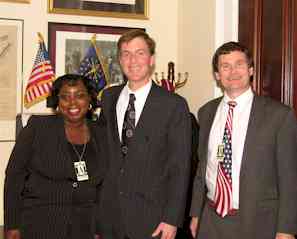
Staff Delivers Petitions to White House |
Hon. George W. Bush
President of the United States
The White House
1600 Pennsylvania Avenue, N.W.
Washington, D.C. 20050
Dear Mr. President:
Accompanying this letter are
20,300 petitions from members and supporters of The Conservative Caucus
asking you to support the Constitution Restoration Act (CRA) (H.R. 1070 and
S. 520).
These 20,300 petitions
supplement the 30,000 which were delivered to you previously.
Anti-Christian judicial tyranny
has become one of the major threats to our liberties and to the continuation
of Constitutional government. The persecution of former Alabama Chief
Justice Moore is a leading example of the bigotry manifested by some Federal
judges.
It is essential that men such
as Roy Moore be protected from Federal judges who abuse their authority by
ignoring the plain language of the Constitution. A Federal judge’s order
for the removal of the Ten Commandments monument from the Alabama Judicial
Building was a violation of the Constitution, and of the Constitutional
requirement for judicial "good behavior".
Therefore, to prevent similar
abuses in the future, I am asking you to support the Constitution
Restoration Act (CRA).
I hope that you will endorse
the CRA and make it a priority for your second term.
Respectfully,
Howard Phillips
Chairman
|
Hillary
Clinton & Panama Ports |
March 2, 2006
|
MIRABILE DICTU:
HILLARY CLINTON NOW
RECOGNIZES THE THREAT TO U.S. SECURITY POSED BY CHINESE COMMUNIST CONTROL OF
CONTAINER PORTS AT BOTH ENDS OF THE PANAMA CANAL
According to NewsMax.com,
"2008 presidential hopeful
Hillary Clinton is expanding her complaint about foreign companies owning
U.S. ports – and now says a 1999 a deal to let a Chinese company takeover
the ports at each end of the Panama Canal was a mistake.
"Speaking at the 92nd
Street YMCA in Manhattan yesterday, Clinton told the Jewish Community
Relations Council: ‘there are those who say we can’t [prevent foreign
governments form operating U.S. ports] because look what happened in the
last 20 years …You know, we have the Chinese running the Panama Canal. We
have other government-controlled entities controlling our ports.’
"Mrs. Clinton neglected to
mention, however, that it was her husband who approved the deal in question,
when the Chinese company, Hutchison Whampoa, sought to buy the Panama Canal’s
ports.
"When security concerns
arose, then-President Clinton insisted that Chinese ownership posed no
threat to canal operations, explaining that Hutchison was ‘bending over
backwards to make sure that they run it in a competent and able and fair
manner’."
ALL IDEAS ARE INHERENTLY
"RELIGIOUS"
According to Professor Howard
M. Friedman of the University of Toledo College of Law, "Yesterday
it was announced that the U. S. Department of Health and Human Services has
entered a settlement with the American Civil Liberties Union in a case
challenging the constitutionality of federal funding of an abstinence-only
sex education program know [sic] as ‘The Silver Ring Thing". … The ACLU
charged that the program was using taxpayer funds to promote religious
doctrines. HHS already suspended funding of SRT in August 2005,
saying that the program ‘may not have included adequate safeguards to
clearly separate in time or location inherently religious activities from
federally-funded activities.’ In yesterday’s settlement…, HHS agreed
that it will not fund SRT’s program as currently structured. In any future
applications for federal funding, SRT must comply with prohibition on using
federal funds to support inherently religious activities. In addition, HHS
agreed to closely monitor any grant applications by SRT for the next two
years. The Alliance Defense Fund, which had intervened in the case to
support SRT, said that it was pleased that SRT would be permitted to apply
for funding in future years."
As Thomas Jefferson observed,
"To compel a man to furnish funds for the propagation of ideas he
disbelieves and abhors is sinful and tyrannical".
The Federal government should
not be funding ideological, philosophical, or political advocacy, whether it
is on the Left or the Right, whether it is Christian or anti-Christian.
But to allege that
abstinence-only sex education is "inherently religious" is, while
correct, a categorization equally applicable to groups which advocate
abortion, sodomy, et cetera.
All ideas are inherently
religious. Christianity is not the only religion. Buggery and baby
butchering reflect a world view that inescapably derives from conclusions
about the nature of divinity, humanity, and morality.
Let’s cut the baloney and cut
off all funding from the Federal Treasury of organizations and activities
which reflect world views whether they be perverse or providential.
|
Visit
HowardPhillips.com every day for the latest commentary, news and action
items in support of restoring our Constitutional Republic |
PLEASE
DONATE
NOW.
To support the many important projects of The Conservative Caucus with a donation,
please call 703-938-9626 or use your credit card.
Thank you. |
|
|